Graduation Project: Real-Time Car License Plate Detection and Recognition
April 9, 2025 2025-04-09 21:32Graduation Project: Real-Time Car License Plate Detection and Recognition
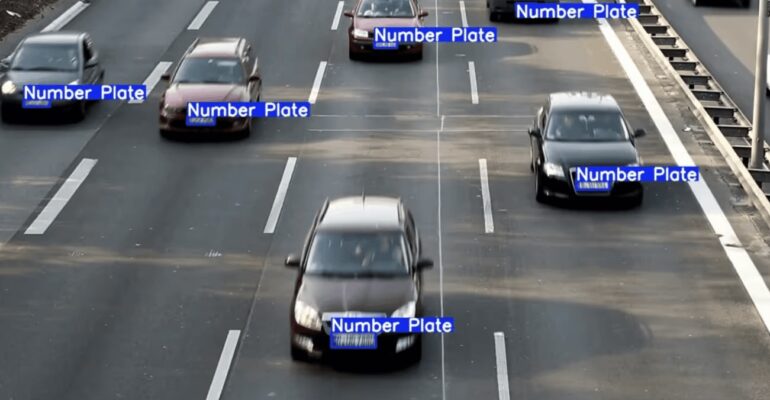
The rapid increase in automobile usage has created significant challenges in traffic management, including vehicle tracking, theft prevention, and law enforcement.
Automatic License Plate Recognition (ALPR) systems play a crucial role in addressing these challenges. This project develops and evaluates a deep learning-based ALPR system capable of real-time processing of video streams. The proposed system leverages Convolutional Neural Networks (CNNs) for accurate license plate detection and character recognition under varied conditions, such as different lighting, angles, and occlusions.
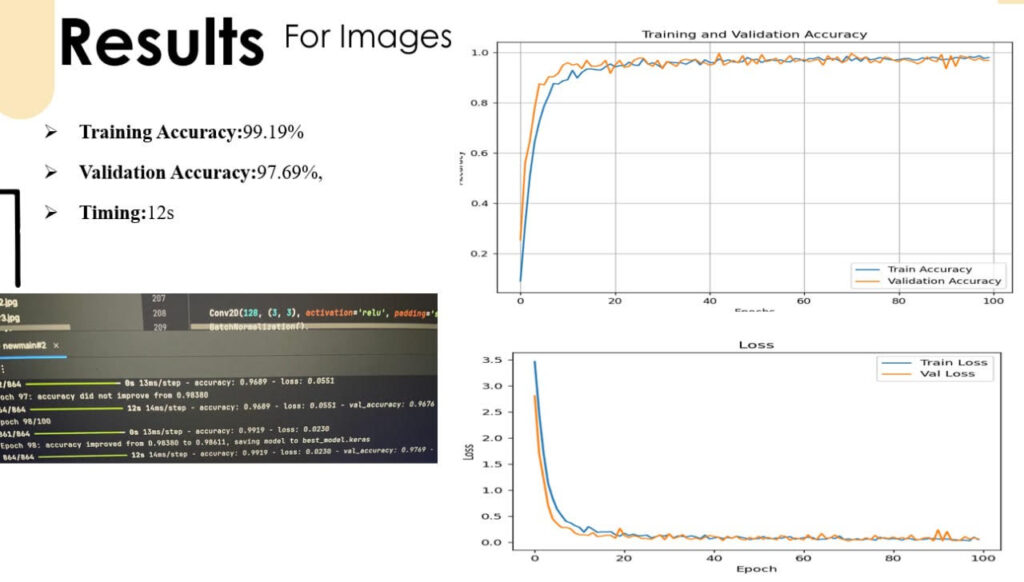
The model utilizes a deep learning architecture featuring convolutional layers, max pooling, dropout, batch normalization, and the ReLU activation function, with SoftMax in the final layer for classification. Preprocessing techniques, including grayscale conversion, thresholding, erosion, and dilation, are employed to enhance image quality. The system is trained on the Al Indian License Plate Recognition dataset , comprising 36 character classes, and achieves a high training accuracy of 99.19% and validation accuracy of 97.69%, the model has been tested on Iraqi license plates and achieved exceptional results.
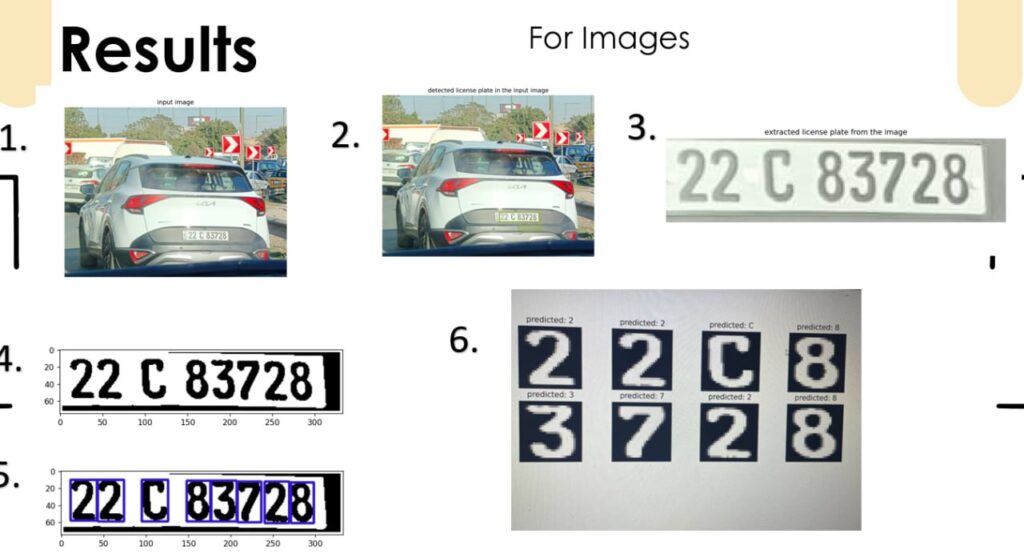
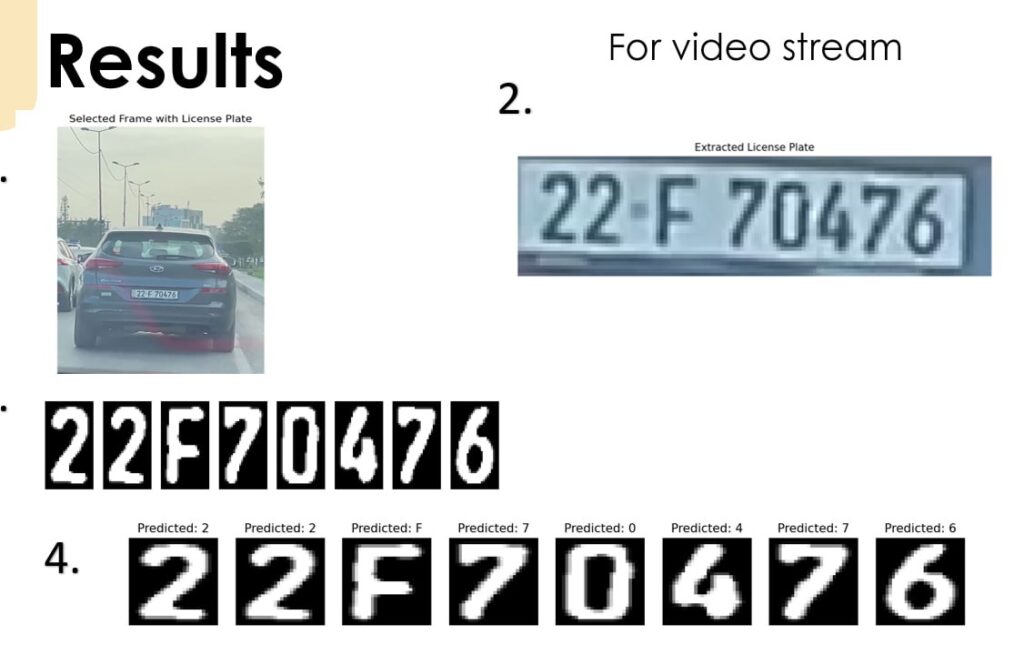
Experimental results demonstrate that the proposed model outperforms traditional approaches in terms of robustness and speed, achieving real-time performance with a processing time of 12 FPS. Compared to the End-to-End ANPR model, which achieves an accuracy of 93.85% with a processing time of 8 FPS, our system exhibits higher accuracy (99.19%) and improved processing speed (12 FPS).
This research highlights the potential of CNN-based ALPR systems for real-world applications such as traffic monitoring, automated toll collection, and law enforcement. Future improvements could focus on optimizing preprocessing techniques and enhancing the model’s adaptability to diverse environmental conditions. This graduation project is the work of the student Ayam Jamal from the Information and Communication Engineering Department, under the supervision of Dr. Yasmine Mazen.