Graduation project -Data Mining algorithms for Cybersecurity
May 29, 2024 2024-05-29 15:31Graduation project -Data Mining algorithms for Cybersecurity
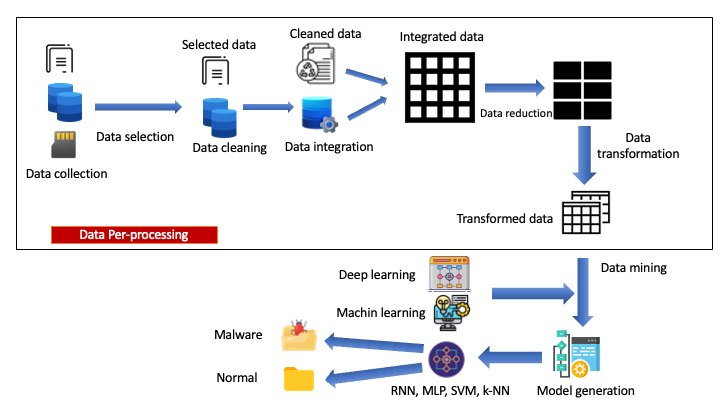
Malware, malicious software designed to harm or exploit any programmable device or network, is a constant threat in today’s digital world. Yasir’s project introduces a novel approach for identifying malware by extracting features from programs using advanced data mining techniques. This extracted data is then analyzed to uncover patterns and behaviors indicative of malicious activity.
The core of the project is structured around a binary classification problem, aiming to categorize software as either benign or malicious. To achieve this, a variety of sophisticated algorithms are employed from both deep learning and machine learning fields. The toolkit includes:
- Multi-Layer Perceptron (MLP)
- Recurrent Neural Networks (RNN)
- Support Vector Machines (SVM)
- k-Nearest Neighbors (KNN)
Among these methods, Support Vector Machines (SVM) stood out for its exceptional performance, achieving an impressive accuracy rate of 97.5% and a remarkably low loss rate of 0.05. This demonstrates SVM’s robustness and reliability in distinguishing malware from legitimate software.
In comparison:
MLP also achieved a 97.5% accuracy rate but with a higher loss rate of 0.15.
RNN reached a 97.0% accuracy rate and a loss rate of 0.11.
KNN managed a 92.0% accuracy rate with a loss rate of 0.072.
These results highlight the effectiveness of AI and machine learning techniques in cybersecurity, showcasing the potential for developing more secure and efficient malware detection systems.
This graduation project is the work of Yasir Ibrahim from the Computer Networks Engineering department, supervised by Asst. Prof. Dr. Ban M. Khammas.